

Dib Bangkok: Thailand's First International Art Museum, A Solo Visitor's Guide
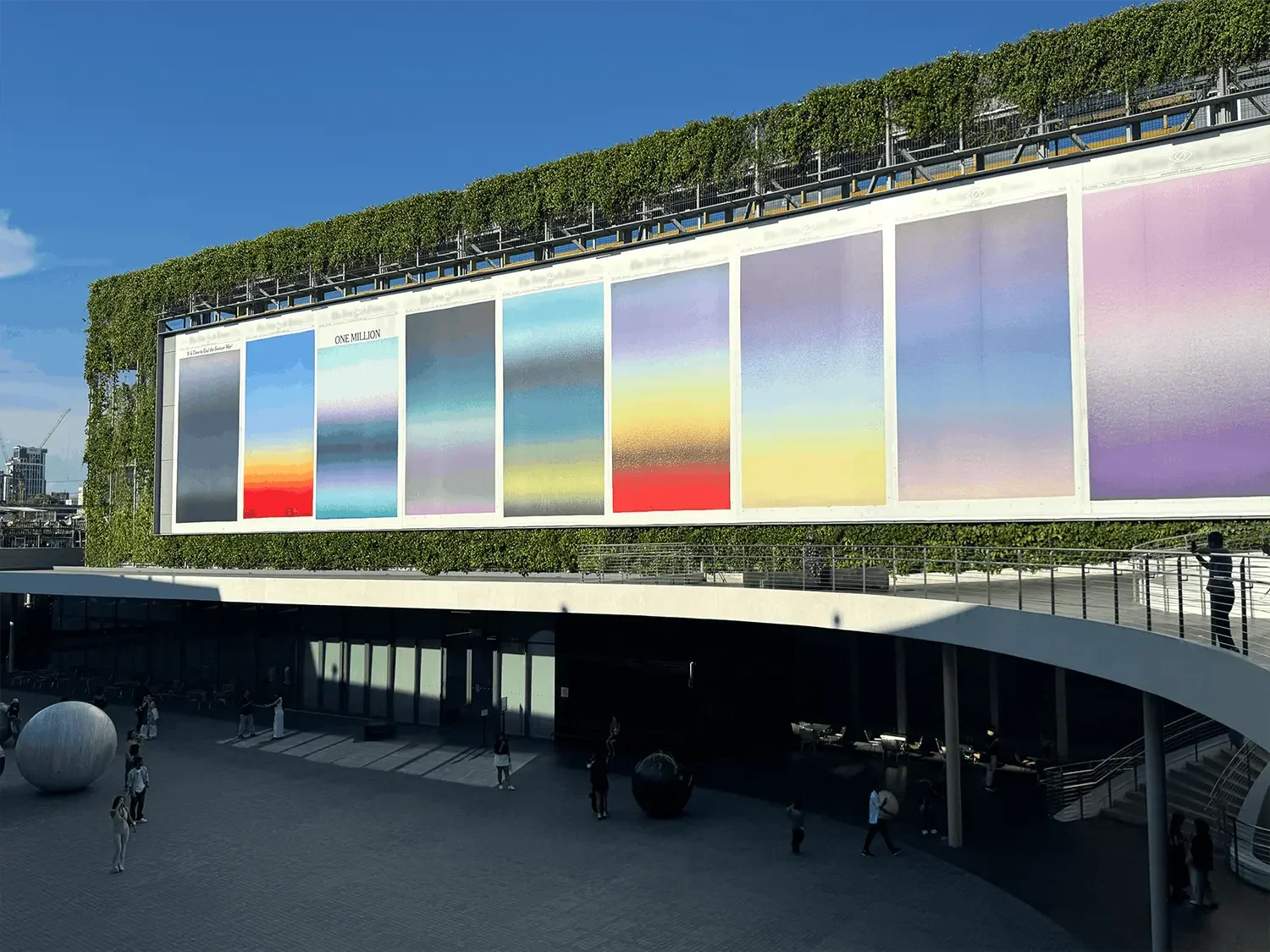
Memory by Sho Shibuya, 85 × 25 metres of sunrise gradients framing the museum courtyard
A Serene, Contemplative Space, Right in the Heart of Bangkok
Bangkok has always been a group travel destination for me: food, temples, shopping, and group massages. Never solo. But Dib Bangkok might just change that.
It was a welcome surprise during a recent group trip: a quiet, peaceful pocket of time I carved out for myself. I'll be adding it to every future Bangkok trip from here on. Here's a quick snapshot of why, before I get into the full experience:
Accessible Location: centrally located, easy to reach, and in a neighbourhood with excellent cafés, shops, and restaurants..
Easy booking: tickets are online, the website is in English, and the process is straightforward. Walk-ins are not recommended, especially if you want to see James Turrell's work.
Timed entry: this keeps crowd levels manageable and the experience genuinely calm. Anyone who has shuffled through an overcrowded museum will appreciate it.
The vibe: peaceful, spacious, and unhurried, indoors and out. The courtyard is open to the public, and even then, it's quiet. No large tour groups in sight, and I hope it stays this way.
James Turrell in Southeast Asia: his works are rare outside the US and Japan. Having a Skyspace this close to home is something I didn't expect and genuinely appreciated.
Time efficient: two to three hours is enough to see everything at a relaxed pace. Easy to slot into a full day without it feeling like a full day commitment.
Planning Your Visit: What to Know Before You Go
How to get there:
The nearest BTS stop is Ekkamai Station, but the walk from there is around 20 minutes. In Bangkok's 40°C heat and humidity, that's a lot.
My recommendation: download Grab (Southeast Asia's equivalent of Uber) and ride directly to the museum. It's affordable, air-conditioned, and stress-free.
Better yet, plan a brunch or coffee stop in the neighbourhood beforehand, so you arrive refreshed rather than overheated.
Unusual Opening Days:
The museum is open fThursday to Monday, 10am to 7pm. Closed Tuesday and Wednesday, so double-check before you go.
The James Turrell Straight Up evening programme runs from around 6:30pm to 7:30pm and requires a separate timed ticket.
Afterwards, the museum's café, Watthu-Dib Bistro & Bar, stays open until midnight, making it a natural place to wind down.
Ticketing and pricing:
All tickets are timed and must be booked online via the museum website.
There is dual pricing: THB 700 for foreign visitors. You will be asked for ID at the entrance, so purchase the correct ticket category. Book Tickets here.
The general entry ticket includes daytime access to the James Turrell Skyspace. However, the sunset programme, which is the highlight, requires a separate timed ticket, booked through a different link. Book James Turrell’s Straight Up evening program here.
Registration is required before entry:
Have your ticket QR code ready.
Before heading to the entry gantry, you need to register at the registration counter first. It's in the same building as the café, which, from the outside, looks like just a café. The lockers are here too.
The museum rep may check your ID at this point.
Arrival: From a Hidden Gate to an Open Courtyard.
The museum sits off the main road, with no large signage to announce it. The entrance is a simple black gate leading into a parking lot, with the actual museum entrance tucked into the left corner of the facade.
From there, a narrow walkway runs alongside a long, dark, reflective pool. The combination of water, sky reflection, and clean modern architecture is a quiet shift from the industrial character of the surrounding neighbourhood. It even seemed to lower the temperature slightly, or maybe that was just my wishful thinking.
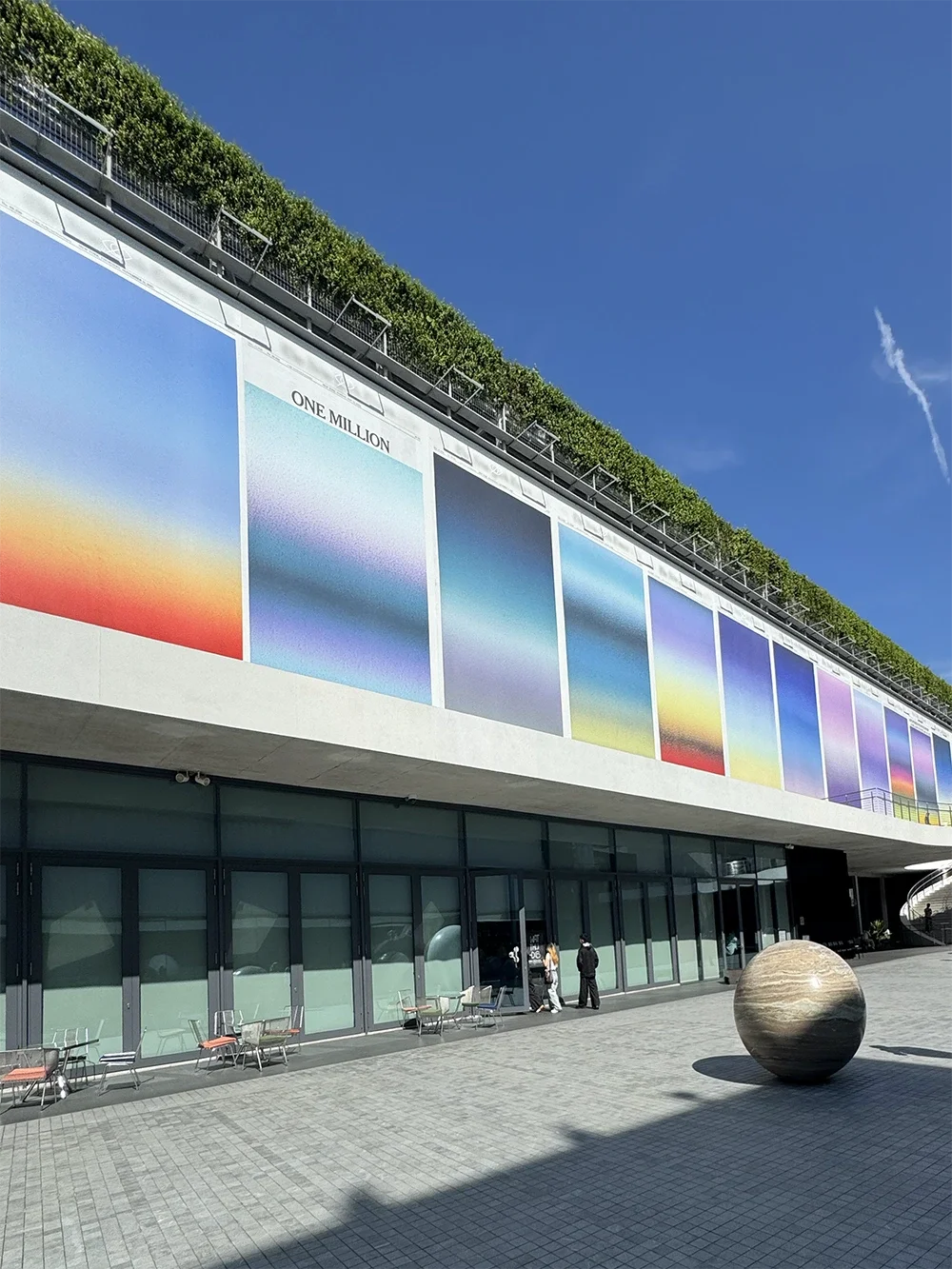
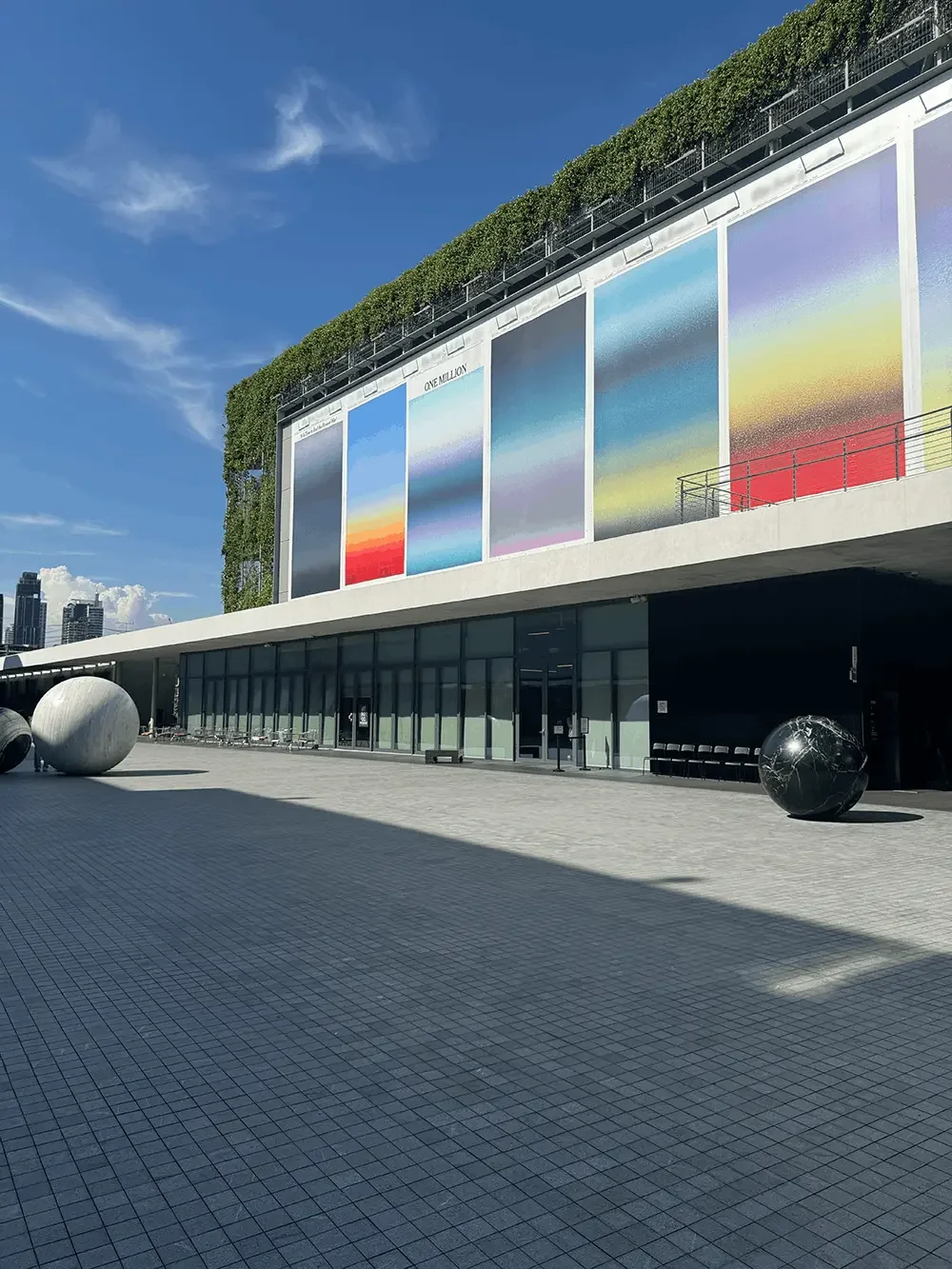
The walkway opens into a wide courtyard where the full scale of the building becomes visible, along with a large mural across the café facade. The mood shifts here: from orderly and serene to open and exploratory. It's the kind of space that naturally makes you ask: where do I go first?
The courtyard is free and open to the public. Scattered freely across it are large marble and ceramic sphere sculptures by Polish-German artist Alicja Kwade, inviting visitors to move through the space, interact with each piece, and take in the museum's exterior from different angles.
Memory, A Wall of Sunrises by Sho Shibuya
One side of the courtyard is anchored by Memory, an 85 × 25-metre mural by Japanese artist Sho Shibuya. It is an artwork specifically done for the museum. It is an extension of his ongoing Sunrise from a Small Window project, in which he paints each day's sunrise, as seen from his own window, onto the front page of a newspaper.
Scaled up to the size of a building facade, the colour gradients read differently depending on where you are in the museum. From the courtyard, it frames the entire outdoor space. From the second-floor balcony, where the original newspaper paintings are on display, you see both the large and the intimate versions side by side, a nice juxtaposition.
The gradient washes are beautiful on their own, but knowing they represent individual mornings painted in real time, now placed outdoors as if facing the sky, adds a layer of meaning that the visuals alone don't convey. I imagine watching it interact with natural light throughout the day is quietly mesmerising. The colours will look different depending on when you visit, which is reason enough to linger.
From the top-floor window, the mural becomes something quieter and more meditative. There are seats by the glass windows here, a quiet invitation to simply sit and watch: the colours shifting in the harsh midday sun, or a shadow moving slowly across the surface as a cloud passes overhead.
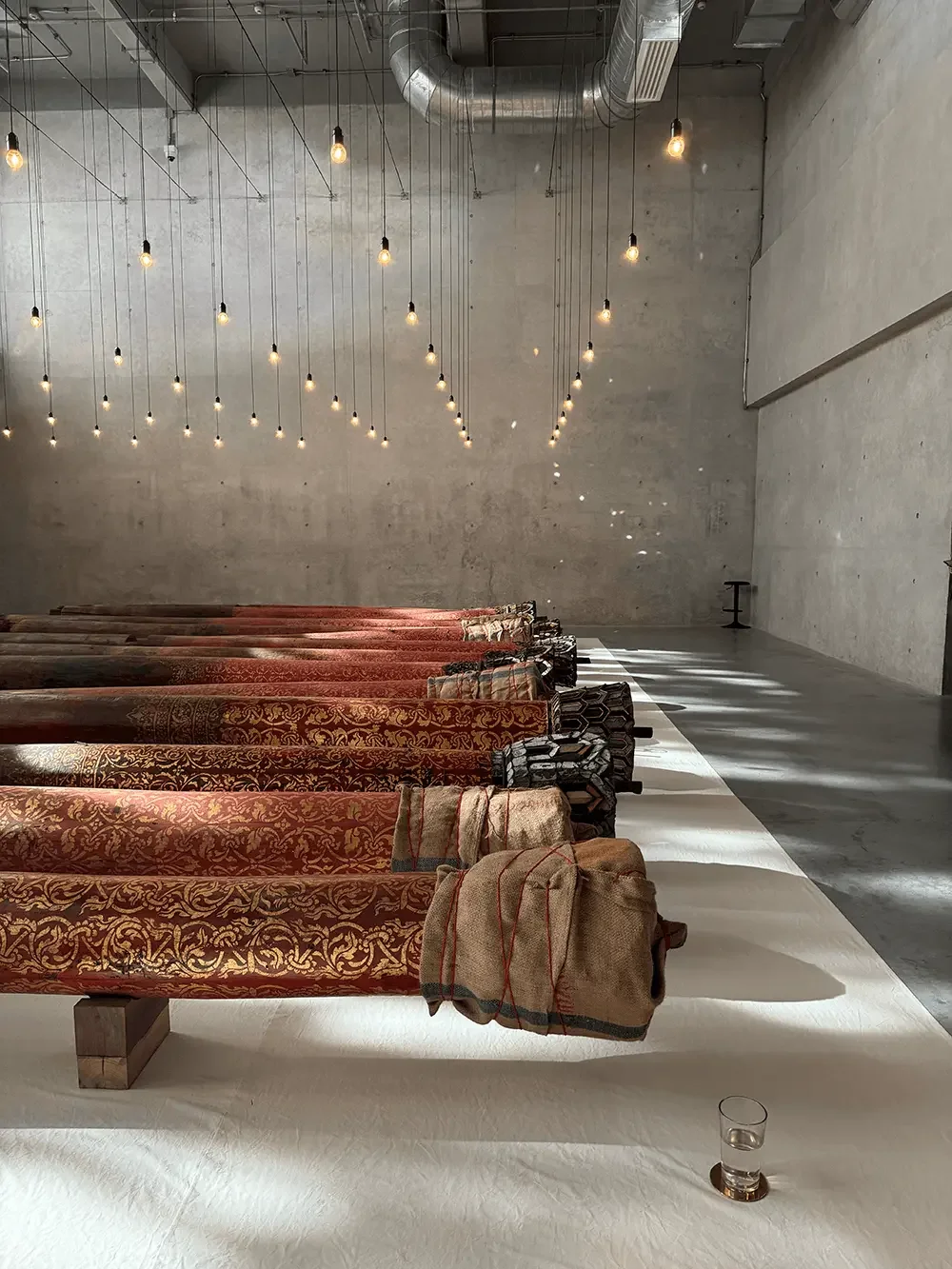
A row of salvaged temple timber beneath a lattice of light. Best experienced in the late afternoon when the shadows shift.

Salvaged timbers, viewed from the opposite side of the room, with a view of the windows.
The Architecture: A Warehouse Reimagined Around Light and Enlightenment
The building was formerly a warehouse, redesigned by Thai-born, LA-based architect Kulapat Yantrasast of WHY Architecture. The design preserves industrial elements of the original structure, including ornamental metal windows and exposed walls, while introducing large glass facades and an abundance of natural light.
The concept draws from the Buddhist idea of enlightenment, especially in how the different floors are designed.
The ground floor is open and spacious, but anchored by thick concrete columns, it is grounded and physical. It encourages movement and exploration.
The second floor feels more compressed and slightly darker, this effect is heightened by the artworks showcased on this floor, which work with the architecture rather than against it.
The top floor opens up entirely; it is airy, light-flooded, and unhurried. I lingered here longer than anywhere else, sitting with the work and looking out across the building at the sun reflecting on the large sunrise murals and the shifting shadows cast on it.
The Exhibition: (In)visible Presence
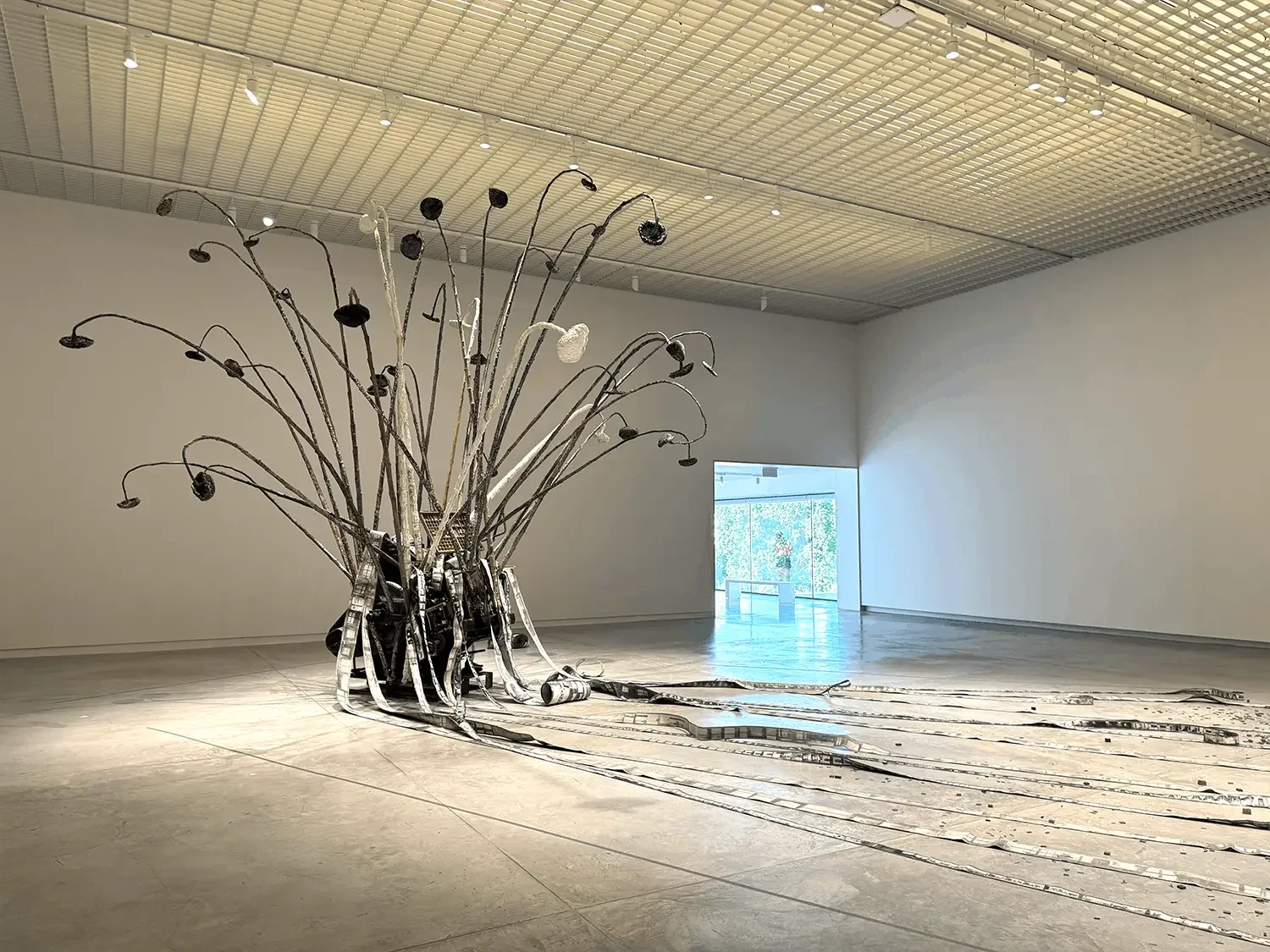
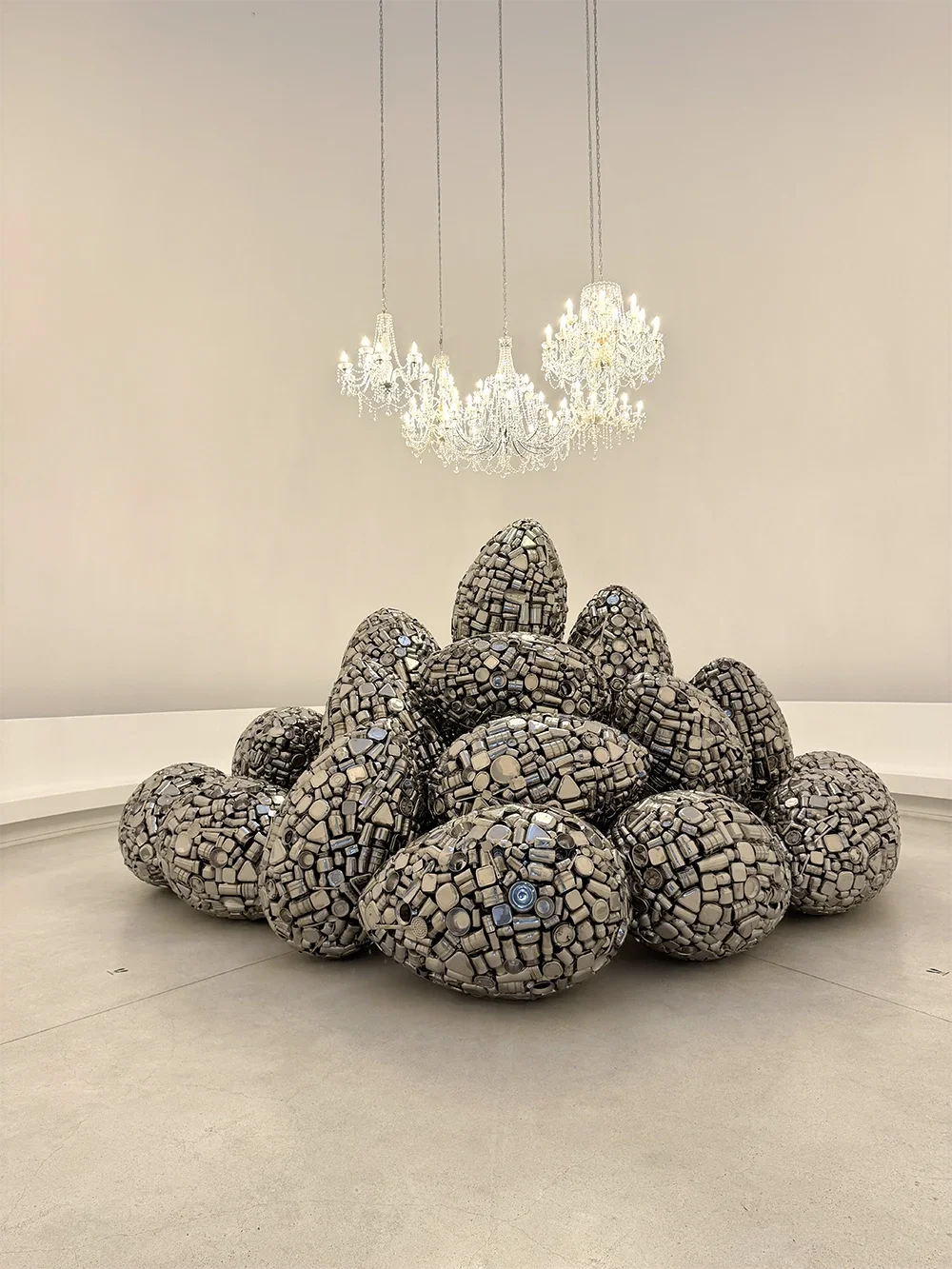
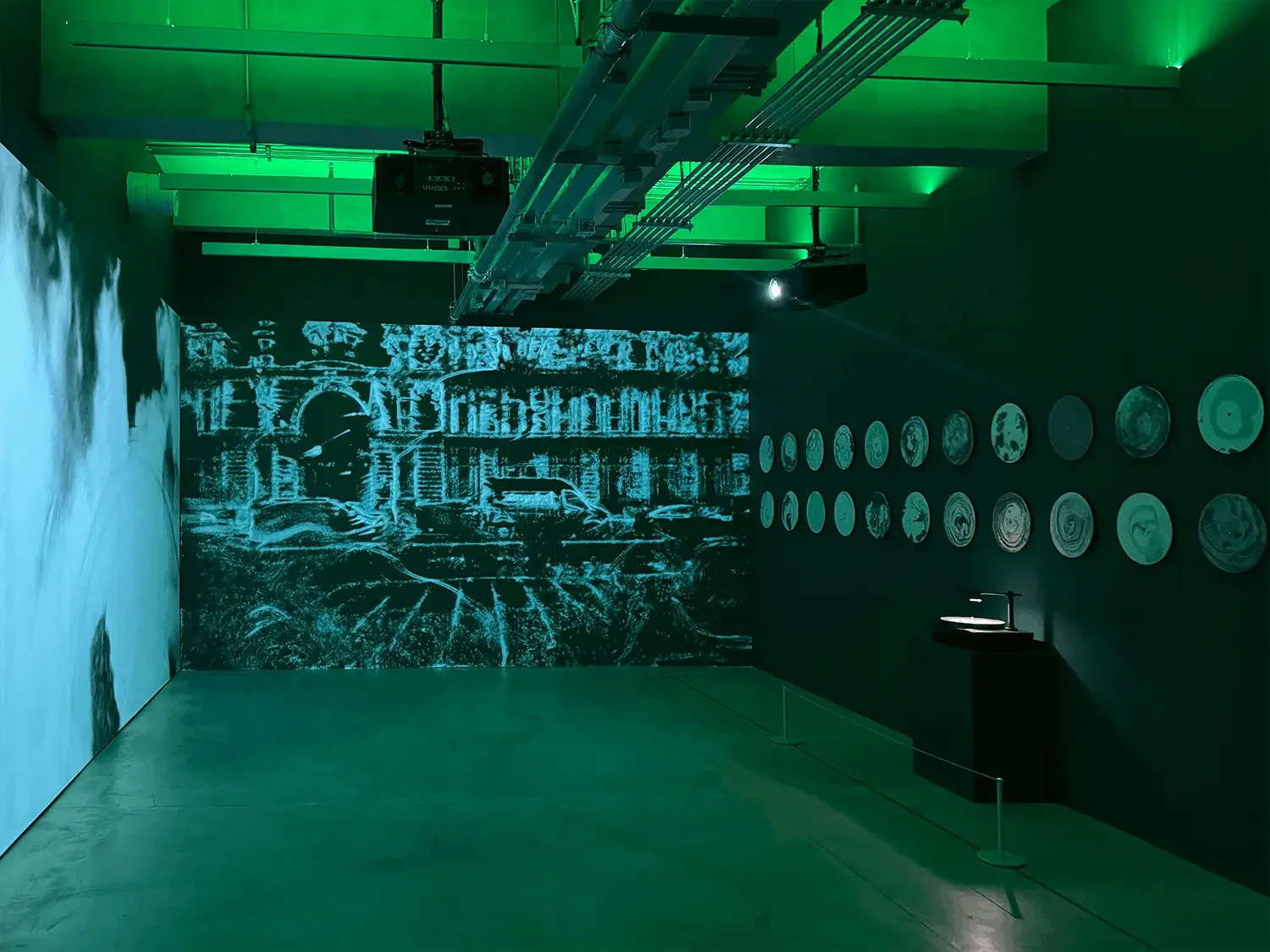
During my visit, a single exhibition spanned the entire museum: (In)visible Presence. What I appreciated most was the balance of well-known Western artists alongside Asian and Southeast Asian artists. The works are not segregated by geography but placed in the same space, in genuine dialogue with one another.
The ground floor is dedicated to more interactive pieces. The opening piece is a sound wall: visitors take turns hitting it with a baseball bat, sending a resonant echo across the entire floor while also leaving a small dent in the surface. It sets a participatory, physical tone.
The second floor shifts to paintings, sculptures, and mixed media and are darker in atmosphere and more introspective. It's bookended by Sho Shibuya's Sunrise from a Small Window installation: small sunrise paintings on newspaper covers, each frame hinged so you can flip it open and read the day's news beneath the painting. There is also a Bangkok edition, a local newspaper from a specific date, with a Bangkok sunrise painted on its cover, a nice contextual touch for the museum itself. These paintings face a glass wall overlooking the large outdoor mural, creating an unexpected and very satisfying loop.
The top floor is the lightest and feels the most spacious of the three. Works are generously spaced, seats are provided, and the tone is contemplative. It's a genuinely good way to close out the experience.
Note: (In)visible Presence runs until 6 August 2026. James Turrell's Straight Up is a permanent installation and will remain after the exhibition closes.
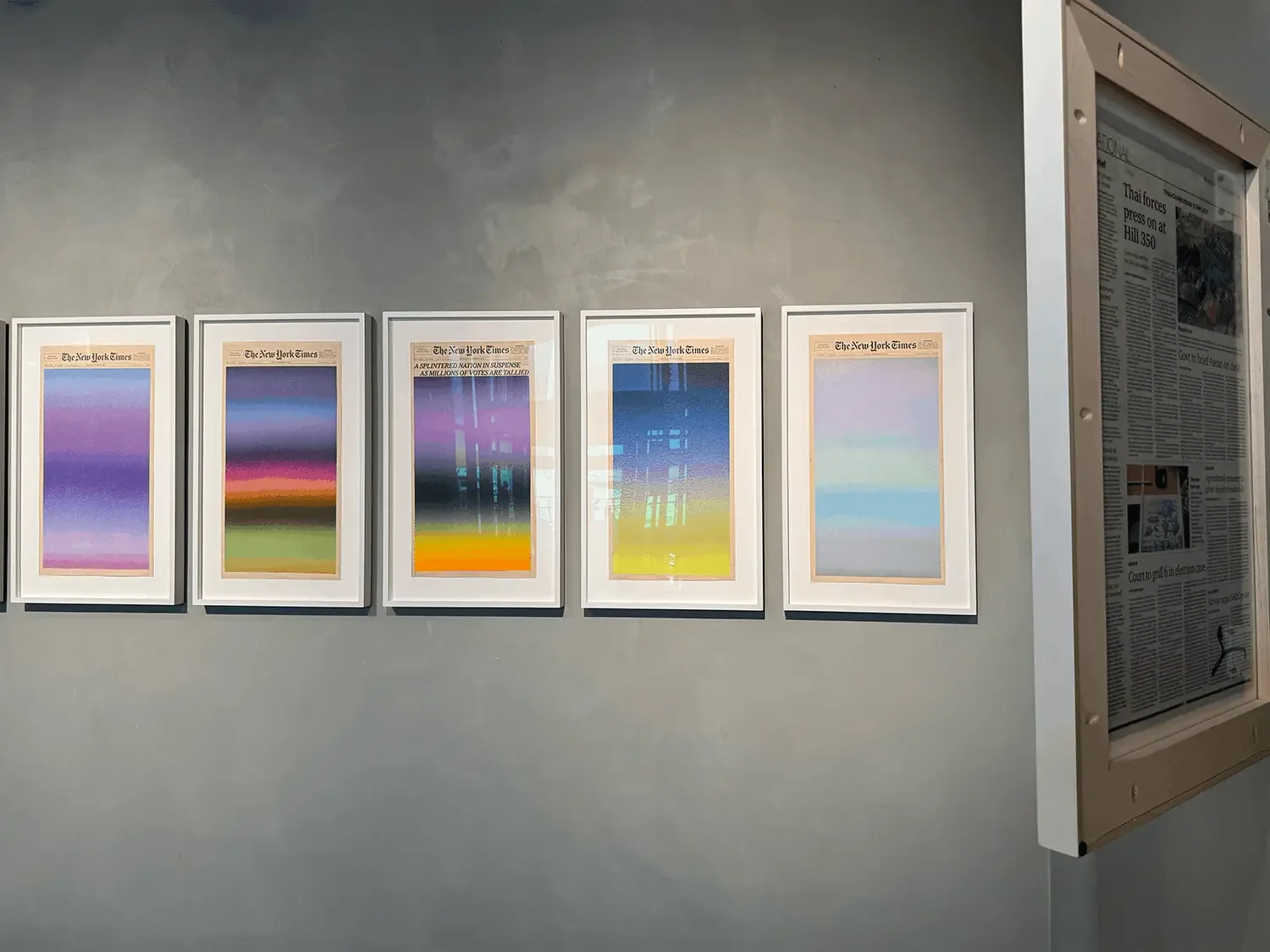
Sunrise from a Small Window by Sho Shibuya. Each frame holds a sunrise painted on that day's newspaper cover. Flip the frame open to read the news beneath
The Sculpture Garden and James Turrell's Straight Up
On the second floor, a glass door facing the Sho Shibuya installation leads to an outdoor sculpture garden. From here, you can view the Memory mural up close, which is a very different experience from the courtyard below, and far better than any photo of it.
Access to James Turrell's Skyspace is also from this garden. You won't miss it: a tall, chimney-like column rises in the centre of the space, with a long, narrow white staircase leading to a small door at the top.
One thing worth flagging: during my visit, a crowd had gathered at the base of the stairs to take photos, which gave the impression that the Skyspace was closed or restricted. It isn't. Ignore the crowd and go up.
The room itself is the smallest Turrell Skyspace I've visited — it comfortably holds around ten people. It's also not air-conditioned, so it gets warm. The intimacy is striking though: even a whisper carries across the room. A very different experience from the Skyspace at Museum SAN in Korea or the Chichu Art Museum in Japan — smaller and more immediate.
A few important notes:
Straight Up comprises two James Turrell works and is part of the museum's permanent collection.
A separate timed ticket is required. Evening slots run approximately 6:30pm to 7:15pm, with 15-minute gaps between sessions. Hours may vary seasonally.
Tickets are THB 250 (~USD 7.50) — the same price for locals and foreigners.

After the Museum: Watthu-Dib Café and the Neighbourhood
You can exit through the main entrance past the gantry, or take the spiral staircase down from the sculpture garden. Either way, the café by the registration counter is a natural place to decompress — coffee, a cold beer, or something light from the menu, which is more extensive than you'd expect from a museum café. The space is generous and unhurried.
The museum shop sits just behind the registration counter. It is small and fairly minimal for now, but hopefully it grows over time. It would be nice to have some official postcards of the artworks and the building.
If you'd rather explore outside, walk toward the main road along Rama IV and Sukhumvit Soi 42. The neighbourhood has a quiet, neighbourhood-local feel with some good options: Rolling Roasters Coffee, After You Dessert Café, and the very popular Phed Mark Basil Pork Rice, if you haven't eaten yet.

Dib Bangkok is worth adding to your itinerary, whether you're there solo or with a group. It offers a rare pause from the heat and noise of the city: quiet, contemplative, and genuinely restorative. A few hours here is all it takes to recharge before the next food or shopping adventure.
Found this helpful? 📌 Pin the images below to save it for later and share the inspiration with others! ❤️